SYMBOLIC LAYING DOWN OF ARMS 2020
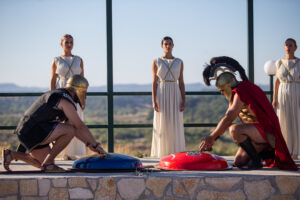
Before the start of the 1st Route of Hercules, in the square of Agrapidochori in the Municipality of Ilida, opposite the hill of Armatova, a small symbolic ceremony of laying down arms by two ancient warriors took place. Opposite the hill where, in antiquity, athletes and spectators of the Olympic Games laid down their weapons at Armatova and entered the “sacred land of Zeus, Ilida” unarmed.
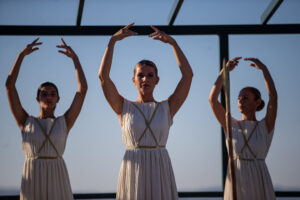
Two warriors dressed in ancient attire and bearing weapons, after laying down their arms, received from priestesses (from the dance school of Mrs. Zoi Andritsou) an olive branch — the eternal symbol of peace and of the Ancient Olympic Games. They then handed these branches to the ultramarathon runner and modern long-distance messenger Giannis Kouros and to the marathon runner and holder of the Greek national records in the Marathon and the 10,000 meters, Director of ASAED, Navy Captain Spiros Andriopoulos, who led the first Route of Hercules.

The two athletes of the Supreme Council for Sports of the Armed Forces (ASAED) were accompanied by distinguished members, including Maria Karpathaki (BEACTIVE ambassador, coach of the Armed Forces & Security Corps National Taekwondo Team and World Champion), Stelios Bispas, Deniz Dimaki, Thanasis Michas, among others. They set off from the square of Agrapidokhori on Saturday morning towards Ancient Ilida. Due to the Pineios Dam (Lake Karamanlis), it was not possible to follow the ancient route; therefore, they passed through the villages of Latas, Efira, Oraia, Keramidia and Dafni, concluding at the theatre of Ancient Ilida, where commemorative awards and medals were presented. The medals, as well as the ancient warriors’ costumes, were created by sculptor Giorgos Roussis, while the commemorative gifts offered to the leaders of the route were designed by sculptor Evangelos Moustakas.
The priestesses participating in the ritual were members of the dance school of Mrs. Zoi Andritsou.


Describing the actions of the Federation of Olympia, its President Sofia Hintziou – Kontogianni reminded that “the laying down of arms and the cessation of hostilities during the period of the Olympic Games constituted the Sacred Truce.
Anyone who did not lay down their arms in Ilida was considered ‘impure’ (enagis), bearing a curse, because the failure to lay down arms was an unholy act.”
Explaining how the Truce was established, Mrs. Hintziou–Kontogianni added:
“Pausanias states that because Greece was torn by civil war and suffered great disasters, mainly from diseases, King Ifitos of Ilida visited the Pythia and asked the Delphic god Apollo how the Greeks could be freed from these calamities.
According to Pausanias, the Pythia advised Ifitos to revive the Olympic Games.
As Strabo also confirms, Ifitos, together with the kings of Sparta, Lycurgus, and of Pisa, Kleosthenes, agreed to declare Elis as ‘sacred to Zeus’ and established the Truce.
The agreement for the Truce was binding not only for the Eleans but for all Greeks.
We cannot determine exactly when the Truce was established, but Aristotle himself confirms its historicity, as it was engraved on the so-called Disk of Ifitos, kept in the Temple of Hera. This disk, which constitutes written evidence of the existence and application of the Truce, as historian Nikolaos Yalouris confirms, dates to the late 8th century BC.
Today, 28 centuries later, we come to establish a running event from the point where Greeks entering Ilida laid down their arms, to the archaeological site of the ancient city.
From here, Agrapidokhori — formerly Armatova — to Ilida is almost 28 kilometers. The ancient route, however, was shorter, as today we are forced to follow lakeside roads, since the old route is covered by the waters of Lake Karamanlis, created by the Pineios Dam.
The route will bear the name of Hercules, whose figure is depicted on the Disk of Ifitos.”

This year, due to the special conditions caused by the COVID-19 pandemic, the race was run exclusively by athletes of the Armed Forces and Security Corps belonging to ASAED.
In time, we believe that the Route of Hercules will become established and will give momentum to an area in need of stepping out of obscurity.
Today, as Greece — and above all the global community — lives under conditions similar to those that forced Ifitos to consult the Pythia and receive the oracle “to renew the Olympic Games,” today more than ever the application of the Truce as an Olympic value is necessary. Something we, as a society and civilization, seem to have forgotten in the revival of the modern Olympic Games.
And just as the Pythia urged Ifitos that the Games should no longer be monetary but crown-based — awarding not material goods but the olive wreath — in order to highlight achievement and spiritual values beyond material ones, so too today we must strive to restore values such as the Truce, which our society so deeply needs.
Thus, we began the 1st Route of Hercules, hoping that we are not simply launching yet another route through a beautiful landscape of Ilida, but a race toward shaping a better society through the application of Olympic values.
Read more about the Route of Hercules 2020 HERE